Digital marketing duties every UK SME needs to know

TL;DR:
- Digital marketing for UK SMEs involves ongoing efforts in SEO, content, social media, PPC, and email marketing, requiring regular planning, execution, and analysis. Ensuring compliance with UK laws like PECR and GDPR, especially in email marketing, is essential to avoid legal penalties and maintain customer trust. Consistent application of core duties and focused strategies, such as SEO and email, yield long-term growth and measurable results.
Running a small business in the UK means wearing a lot of hats, and digital marketing is one that can feel particularly awkward at first. Many business owners know they need to be visible online, but struggle to pin down exactly what that requires on a practical, day-to-day level. The good news is that digital marketing duties are far more structured than the jargon suggests. This guide breaks them down channel by channel, covers the compliance essentials you cannot afford to skip, and shows you how to track the efforts that actually move your business forward.
Table of Contents
- What digital marketing duties really involve for UK SMEs
- Compliance essentials: Email marketing and UK law
- Ongoing optimisation and reporting: Making your results count
- Bringing it all together: Integrating duties for SME growth
- The uncomfortable truth about digital marketing duties for SMEs
- Take the next step with expert SME marketing support
- Frequently asked questions
Key Takeaways
| Point | Details |
|---|---|
| Core duties clarified | Digital marketing duties cover planning, creating, optimising, and reporting across channels. |
| Compliance is critical | Legal rules for email and data apply to every UK SME—failures can cost your business. |
| Track what matters | Focusing on actionable metrics, not vanity numbers, boosts marketing effectiveness. |
| Simplicity drives results | Simple, repeatable routines consistently outperform chasing every new trend. |
What digital marketing duties really involve for UK SMEs
Understanding where to focus your energy starts with knowing what digital marketing actually covers. The core channels are SEO (search engine optimisation), content marketing, social media, PPC (pay-per-click advertising), and email marketing. Each one has a distinct role, and each one comes with its own ongoing responsibilities.
According to the Digital Marketing Institute, digital marketing duties span tactics including SEO, social media, email marketing, and paid advertising, and they include monitoring analytics and optimising based on results. This is important to absorb: marketing is not a one-off task. It is a cycle of planning, doing, measuring, and refining.
Here is how the main channels compare in terms of what they demand from you week to week:
| Channel | Primary duty | Time commitment | Key metric |
|---|---|---|---|
| SEO | Optimising content and technical site health | Monthly | Organic traffic and rankings |
| Content marketing | Writing, scheduling, and updating content | Weekly | Engagement and time on page |
| Social media | Posting, responding, and community building | Daily or several times weekly | Reach, clicks, and engagement rate |
| PPC (paid ads) | Setting up, monitoring, and adjusting campaigns | Weekly | Cost per click and conversion rate |
| Email marketing | Building lists, creating campaigns, and tracking open rates | Bi-weekly or monthly | Open rate, click rate, and unsubscribes |
For a time-poor business owner, a sensible weekly routine might look like this: Monday to review last week’s website traffic data, Wednesday to publish a blog or social post, and Friday to check the performance of any active paid campaigns. Monthly, you would review your overall KPIs and adjust what is not working. It sounds manageable because it is, when you approach it consistently.

Our practical digital marketing guide goes deeper on how to build this kind of structured routine without burning out or spreading yourself too thin.
A few duties that business owners often underestimate:
- Content creation and scheduling: Regular, relevant content signals authority to both search engines and potential customers.
- Analytics review: Checking what is and is not working allows you to redirect effort towards what drives results.
- Competitor monitoring: Knowing what others in your space are doing helps you spot gaps and opportunities.
- Audience engagement: Responding to comments, queries, and reviews builds trust in ways that no ad budget can replicate.
For genuinely useful content marketing tips that avoid the hollow SEO fluff trap, focusing on authentic, audience-first content is what consistently performs well in 2026.
The reason consistent execution matters so much is simple: digital marketing rewards persistence. A business that publishes one good article per month for twelve months will almost always outperform one that publishes twelve articles in January and then stops. The algorithm and your audience both respond to reliability. If you want to see more digital marketing strategies that suit small businesses in the UK specifically, our resource library has practical options suited to different industries and budgets.
Compliance essentials: Email marketing and UK law
Now that the main duties are laid out, let us cover the compliance essentials, since getting these wrong can undo your best marketing efforts and expose you to significant financial and reputational risk.
Email marketing sits at the intersection of two pieces of legislation: PECR (Privacy and Electronic Communications Regulations) and UK GDPR. In plain English, this means you must have a valid reason to contact someone by email, you must tell them who you are, and you must make it easy for them to stop receiving your messages.
The ICO (Information Commissioner’s Office) is clear that email marketing under UK law requires a valid lawful basis and respect for opt-out preferences. Ignore this and you are not just risking a fine. You are eroding the trust you have worked hard to build.
A compliant email marketing campaign must include:
- Explicit consent (or a valid legitimate interest basis) obtained before sending.
- Clear identification of your business in every email.
- An easy, functional unsubscribe option in every message.
- Secure storage of subscriber data, with no sharing without permission.
- Accurate records of when and how consent was given.
One area that confuses many SMEs is the difference between B2C and B2B rules. For consumers, consent is almost always required before you send a marketing email. For business-to-business communications, the rules are slightly different. According to the ICO, B2B marketing may not always require PECR consent when contacting corporate subscribers such as limited companies or LLPs. However, the moment you are contacting an individual at a small business, a sole trader, or a partnership, data protection rules apply fully and consent or the soft opt-in rule must be considered carefully.
This nuance catches a surprising number of businesses off guard. Just because you are emailing a work address does not automatically make it a corporate contact in the eyes of the law.
ICO guidance: “You must have a clear and honest opt-out in every direct marketing message you send, and you must act on opt-out requests promptly.”
Pro Tip: Before you send your next campaign, run through this quick checklist. Did this person explicitly agree to receive emails from you? Does every email clearly show who it is from? Is the unsubscribe link visible and working? Have you updated your list to remove anyone who has opted out? If the answer to any of those is no, pause before you hit send.
Understanding your digital marketing KPIs alongside compliance means you can track unsubscribe rates and complaint figures as early warning signs that your email approach needs adjusting, not just legally but strategically.
Ongoing optimisation and reporting: Making your results count
Once email and legal compliance are sorted, the next duty is about ongoing learning and improvement. Raw data is only useful when you know what to do with it.
The reality is that most small business owners look at their analytics only when something goes wrong. A much better approach is to build a regular review habit, ideally weekly for active campaigns and monthly for overall performance. Consistent analytics monitoring and optimisation based on results are core duties of effective digital marketing, and skipping this step means your budget and effort are being guided by guesswork.
Here is a straightforward table of the KPIs worth tracking and what they actually mean for your business:
| KPI | What it measures | Why it matters for SMEs |
|---|---|---|
| Organic traffic | Visitors from search engines | Shows whether your SEO efforts are working |
| Bounce rate | Percentage of visitors who leave without clicking | High bounce rates suggest poor page relevance or slow load times |
| Email open rate | How many recipients open your emails | Indicates subject line quality and list health |
| Conversion rate | Percentage of visitors who take a desired action | Directly tied to revenue and lead generation |
| Cost per acquisition (CPA) | How much you spend to gain one customer | Helps assess whether paid campaigns are profitable |
| Social engagement rate | Likes, shares, and comments as a proportion of reach | Shows how relevant your content is to your audience |
A simple reporting workflow for business owners:
- Set your baseline. At the start of any campaign, note your current traffic, conversion rate, and email stats so you have a meaningful point of comparison.
- Check weekly metrics. Look at active campaigns and flag anything that is significantly over or under performing.
- Conduct a monthly review. Assess all channels together, compare to the previous month, and identify where effort is best redirected.
- Make one or two changes. Resist the temptation to overhaul everything at once. Small, deliberate adjustments are easier to measure and learn from.
- Document your findings. Even a simple spreadsheet tracking monthly results builds an invaluable record over time.
Our resources on measuring marketing KPIs and digital marketing KPIs give you a clear framework for knowing which numbers to prioritise at each stage of growth.
Pro Tip: Focus on metrics that are directly tied to business outcomes, not just numbers that feel impressive. A social post with ten thousand impressions but zero enquiries is far less valuable than a blog post that generates five leads per month. Vanity metrics can mislead you into thinking things are going well when the business is standing still.
Bringing it all together: Integrating duties for SME growth
With the individual duties covered, here is how everything fits together into a manageable system for growth.
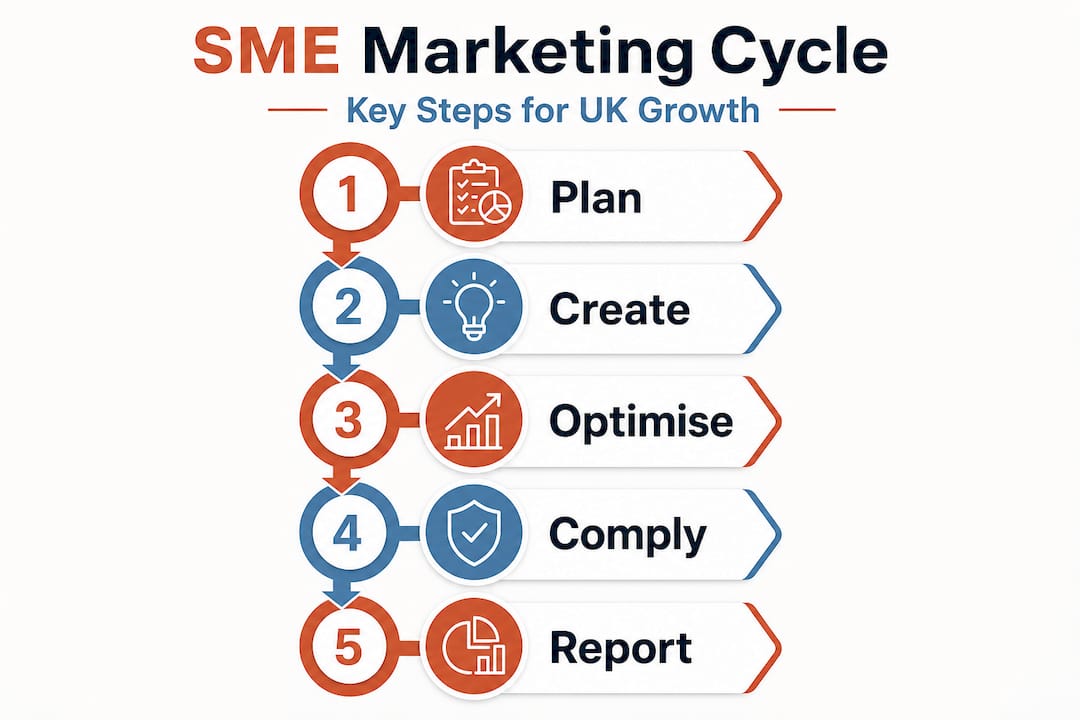
The cycle that underpins effective digital marketing is straightforward: plan, execute, evaluate, and optimise. This is not a quarterly project. It is an ongoing rhythm that, when maintained consistently, compounds over time into meaningful business results.
The ongoing cycle looks like this:
- Plan: Set specific goals and choose the channels most relevant to your audience and budget.
- Execute: Produce and publish content, run campaigns, and build your email list.
- Evaluate: Review your KPIs and identify what is and is not working.
- Optimise: Adjust your approach based on evidence, not instinct alone.
When these duties are integrated rather than treated as separate tasks, the results are qualitatively different. Your SEO improves because your content strategy is consistent. Your email list grows because your social presence drives sign-ups. Your PPC campaigns become cheaper because your landing pages are better optimised. Everything supports everything else.
The revenue impact of integrated digital marketing is significant: digital marketing duties tied to leads and revenue planning, execution, monitoring, and optimisation across major channels consistently outperform ad hoc or siloed approaches. Businesses that treat digital marketing as a structured discipline, rather than an occasional activity, report stronger customer retention, higher conversion rates, and better return on their marketing spend.
If you are time-poor, the honest answer is to prioritise SEO and email marketing first. Both offer long-term compounding returns. SEO builds organic visibility that you do not have to pay for repeatedly. Email marketing reaches an audience that has already shown interest. Together they create a foundation from which you can build. Our SME digital marketing guide gives a practical step-by-step starting point, and our resource on a smart strategy for SMEs covers how to sequence your activities for maximum impact in 2026.
The uncomfortable truth about digital marketing duties for SMEs
Here is something we see time and again: the businesses that struggle most with digital marketing are rarely doing too little. They are doing too many things inconsistently. They have heard about TikTok and wonder if they should be on it. They have read about AI-generated content and think they need to adopt it immediately. They dabble in PPC for a few weeks, see no immediate return, and abandon it before it has had time to work.
The uncomfortable truth is that digital marketing fads cycle fast, but the fundamentals change very slowly. SEO has been the backbone of online visibility for over two decades. Email marketing still delivers some of the highest returns of any digital channel. Consistent, relevant content still builds more trust than any paid shortcut. The businesses we see making real progress are the ones who have committed to doing the basics well, every week, without chasing the next shiny tactic.
The confusion is not entirely the business owner’s fault. The marketing industry has an interest in selling complexity. New platforms, new tools, new algorithms: each one arrives with breathless coverage suggesting it will change everything. Most of the time, it does not. The business that learns what actually works in SME growth finds that a repeatable system built on the core duties consistently beats an aggressive but scattered approach.
Our editorial view is this: simplify first. Get your SEO in order. Build a compliant, engaged email list. Publish useful content on one or two channels your customers actually use. Track three or four KPIs that matter to revenue. Do that for six months. Only then should you consider adding new channels or tactics. The businesses that follow this path are the ones who call us saying their leads have doubled, not the ones who tried everything at once and burned out.
Take the next step with expert SME marketing support
If this guide has helped you see your digital marketing duties more clearly, the next question is usually a practical one: how do you make it happen alongside everything else you are managing?

At Kickass Online, we work with a deliberately limited number of UK SMEs at a time, precisely because proper digital marketing support requires genuine attention, not a generic template applied to every client. Whether you need a fully integrated digital marketing strategy for your SME built from scratch, or targeted help with specific duties like SEO or email compliance, we can provide tailored guidance that fits your business. We have supported businesses across a range of sectors to put the fundamentals in place and generate measurable results. If you want to see examples of successful small business marketing in action, our case studies are a good place to start. Book a consultation and we can talk through what your priorities should be.
Frequently asked questions
What are the most important digital marketing duties for a UK SME?
The most vital duties include planning campaigns, creating content, monitoring analytics, ensuring legal compliance, and optimising activities to drive leads and revenue. As the Digital Marketing Institute confirms, core duties span planning, execution, optimisation, and reporting tied to business outcomes.
Do I need consent to email other UK businesses?
Consent is not always required for corporate subscribers such as limited companies, but data protection rules still apply, and you must act on any opt-out requests promptly. The ICO notes that B2B contacts at sole trader or partnership level are treated the same as individual consumers under data protection law.
How often should I review my digital marketing results?
Review your analytics at least once a month to identify trends and spot opportunities for improvement. Ongoing optimisation based on results is one of the defining duties of effective digital marketing for any business size.
What could happen if I ignore email marketing compliance?
Ignoring PECR and UK GDPR can result in fines from the ICO, reputational damage, and loss of customer trust. The ICO makes it clear that every marketing email must have a valid lawful basis and include a clear, functioning opt-out.
Recommended

Book A Discovery Call
Stay Connected