What is online marketing? A guide for small business owners

TL;DR:
- Online marketing involves promoting your business through various digital channels like SEO, social media, and email.
- Building a strong, mobile-friendly website is essential as it serves as the core of all online marketing efforts.
- Focus on a few targeted channels, measure results regularly, and consider professional support for growth.
If you run a small or medium-sized business, you have probably been told to “get online,” “build your brand,” or “grow your digital presence” without anyone explaining what that actually means in plain terms. The jargon is everywhere: SEO, PPC, funnels, content marketing, organic reach. It can feel overwhelming. This guide cuts through the noise. By the end, you will know exactly what online marketing is, which methods matter most for businesses like yours, how to build a solid foundation, and how to measure whether any of it is actually working.
Table of Contents
- Defining online marketing: The fundamentals
- Core online marketing methods and channels
- Building your foundation: Why your website matters most
- Choosing your strategy: Application and measurement
- The uncomfortable truth: What most ‘online marketing advice’ misses for small businesses
- Scale your online marketing with professional support
- Frequently asked questions
Key Takeaways
| Point | Details |
|---|---|
| Clear definition | Online marketing leverages digital channels like websites, search, and social to reach and engage audiences efficiently. |
| Focus matters | For SMEs, prioritising just a few channels delivers better results than trying to do everything online. |
| Website is core | A strong, mobile-friendly business website is the essential foundation for all online marketing efforts. |
| Measure and adapt | Successful online marketing means tracking what works and regularly improving based on data. |
Defining online marketing: The fundamentals
Let’s start with clarity. Online marketing, also known as digital or internet marketing, is the practice of promoting products, services, or brands using digital channels such as search engines, social media, email, websites, and paid advertising. That is it. No mystery.
You will often hear the terms “online marketing,” “digital marketing,” and “internet marketing” used interchangeably, and for most practical purposes they mean the same thing. The key distinction is that online marketing specifically refers to activity that happens over the internet, whereas “digital marketing” can technically include offline digital channels like SMS or digital billboards. For small business owners, this difference rarely matters day to day.
What does matter is understanding why this shift is so significant. Buyer behaviour has changed fundamentally. Most people now research a product, read reviews, and compare options online before ever speaking to a business. If you are not visible in those digital moments, you are missing opportunities constantly.
Online marketing is also not just social media or Google Ads. That is one of the most common misconceptions we hear from business owners. Digital marketing for small business spans a much wider set of channels, including:
- Search engine optimisation (SEO): Improving your website so it appears in search results organically.
- Pay-per-click advertising (PPC): Paid adverts on Google, Bing, or other platforms where you pay per click.
- Social media marketing: Building presence and engagement on platforms like Instagram, Facebook, or LinkedIn.
- Content marketing: Creating blog posts, videos, or guides that attract and educate potential customers.
- Email marketing: Communicating directly with leads and customers via email campaigns.
- Local marketing: Optimising your presence on tools like Google Business Profile so nearby customers find you first.
“The most important thing to recognise is that online marketing is a system, not a single tactic. Each channel feeds into the others, and the businesses that treat it as a whole are the ones that grow consistently.”
Ignoring any one of these channels entirely may not be a disaster, but understanding how they fit together is the first step to making smart decisions for your business.
Core online marketing methods and channels
Now that the basics are clear, let’s explore the main digital marketing methods and how they actually work together for small businesses.
Effective channels for SMBs include SEO for organic visibility, PPC for immediate traffic, content marketing to attract and nurture leads, social media for engagement and community building, email marketing for retention (with the highest ROI), and local marketing via Google Business Profile. Here is a breakdown of the six most impactful:
- SEO (search engine optimisation): Helps your website rank higher in Google search results without paying for clicks. Takes time but builds lasting visibility.
- PPC (pay-per-click advertising): Places your business in front of searchers immediately. You pay per click, so budgets can be tightly controlled.
- Content marketing: Blog posts, how-to guides, and videos that answer your customers’ questions and build trust over time.
- Social media marketing: Builds community, drives engagement, and keeps your brand visible where your customers spend their time.
- Email marketing: One of the most cost-effective channels available. Direct, personal, and entirely within your control.
- Local SEO and Google Business Profile: Critical for any business with a physical location or a defined service area. Explore local SEO strategies if you want to dominate your local market.
These channels are not isolated. A strong blog post improves your SEO, gets shared on social media, and can be repurposed into an email newsletter. That is the power of thinking about online marketing as an interconnected system rather than separate activities.
| Channel | Strength | Cost level | Time to results | Ease of use |
|---|---|---|---|---|
| SEO | Long-term visibility | Low to medium | 3 to 6 months | Moderate |
| PPC | Immediate traffic | Medium to high | Immediate | Moderate |
| Social media | Engagement and brand awareness | Low to medium | 1 to 3 months | Easy |
| Content marketing | Trust and lead nurturing | Low | 3 to 12 months | Moderate |
| Email marketing | Retention and highest ROI | Very low | Immediate | Easy |
| Local SEO | Nearby customer discovery | Low | 1 to 3 months | Easy |
For a broader overview of internet marketing channels and how they interact, HubSpot’s resource library is particularly useful for business owners getting started.
Pro Tip: Resist the urge to be active on every channel at once. Pick two or three that align with where your customers actually spend time and go deep on those first. Breadth without depth rarely produces results for small teams. You can find proven marketing strategies for SMBs to help you make that choice wisely.
Building your foundation: Why your website matters most
Once these methods are clear, it is vital to address the most critical asset driving all your digital marketing: your business website.

Your website is not just a digital brochure. It is the centrepiece of your entire online marketing effort. Every channel, whether it is an Instagram post, a Google Ad, or an email campaign, ultimately directs people back to your website. If that destination is slow, confusing, or unprofessional, all your other marketing spend is wasted.
A strong business website must be mobile-friendly, fast-loading, and built with consistent branding before you scale any other tactic. Here is what that looks like in practice:
- Mobile responsiveness: Over 60% of web traffic now comes from mobile devices. A site that looks broken on a phone will lose visitors immediately.
- Page speed: Slow sites frustrate users and are penalised by Google. Aim for pages that load in under three seconds.
- Clear branding: Consistent colours, fonts, and messaging that reflect who you are and what you offer.
- Obvious calls to action: Every page should guide visitors towards a next step, whether that is booking a call, making a purchase, or signing up to your mailing list.
- Basic SEO structure: Page titles, meta descriptions, and structured content help search engines understand your site.
Understanding how web design boosts sales is not a luxury consideration. It is directly connected to how much revenue your online marketing generates.
Pro Tip: Prioritise “owned assets” above all else. Your website and email list are assets you control completely. Social media platforms change their algorithms, ad costs fluctuate, and third-party tools come and go. Your website and mailing list remain yours regardless of what happens elsewhere.
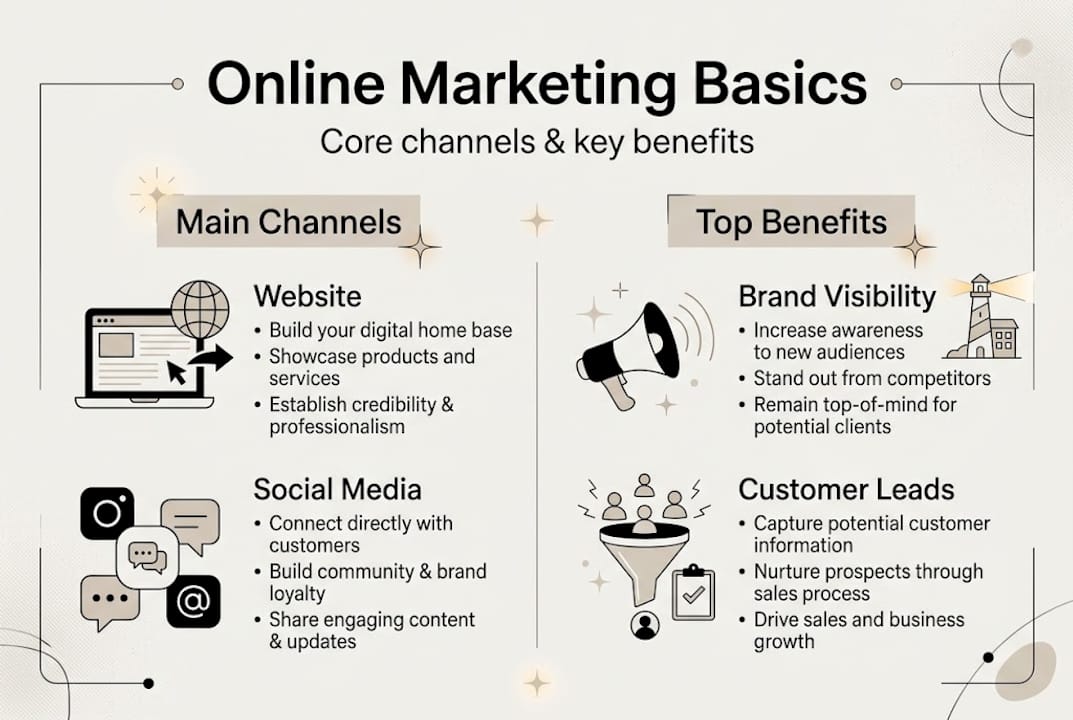
Free or outdated websites hold businesses back more than most owners realise. A site built on a free platform with limited functionality often cannot be properly optimised for SEO, loads slowly, and lacks the credibility that converts visitors into customers. The digital marketing for small business landscape in 2026 is competitive enough that a professional, well-maintained website is no longer optional. It is the price of entry.
Choosing your strategy: Application and measurement
A solid foundation sets you up to take action. Here is how to choose your strategies, put them into practice, and measure what matters.
The biggest mistake small business owners make is choosing channels based on what sounds impressive rather than what aligns with their actual goals. Before you invest time or money, follow these steps:
- Define your goal clearly. Are you trying to attract new customers, retain existing ones, or increase average order value? Each goal points to different channels.
- Identify where your customers actually are. If your customers are local tradespeople, LinkedIn may not be where you find them. If they are consumers aged 25 to 45, Instagram or Google search may be ideal.
- Pick your top two or three channels. Prioritise 2 to 3 channels rather than spreading yourself thin. Local SEO, email, and Google Ads is a strong starting combination for most SMEs.
- Set a simple baseline metric for each. Website visitors, email open rates, conversion rates. Keep it measurable.
- Review and optimise monthly. Set a recurring calendar event to check your numbers and adjust accordingly.
| Channel | Typical goal | Top success metric |
|---|---|---|
| SEO | Organic visibility | Organic traffic growth |
| PPC | Immediate leads or sales | Cost per conversion |
| Social media | Brand awareness and engagement | Reach and engagement rate |
| Email marketing | Customer retention | Open rate and click-through rate |
| Local SEO | Foot traffic or local enquiries | Google Business Profile views |
For guidance on what good results actually look like, explore measuring marketing ROI so you can set realistic benchmarks from the start.
Pro Tip: Install Google Analytics and Google Search Console from day one. Both are free, both provide essential data, and both will tell you clearly what is working and what is not. Without them, you are making decisions based on gut feeling rather than evidence.
For further reading on building an effective plan, internet marketing best practices from Salesforce offers practical frameworks that translate well for smaller teams. You can also explore digital strategies for SMEs that are specifically tailored to businesses with limited budgets and resources.
The uncomfortable truth: What most ‘online marketing advice’ misses for small businesses
Most online marketing advice tells you to “be everywhere.” Post daily on five platforms, run ads, write blogs, send emails, do podcasts, and somehow grow your business at the same time. For a small team managing actual client work, that advice is not just impractical. It is actively harmful.
The businesses we have seen grow consistently are not the ones doing the most. They are the ones doing a few things exceptionally well and building owned audiences they control. An email list of 1,000 engaged subscribers is worth more than 10,000 social media followers on a platform that can throttle your reach overnight.
There is also an uncomfortable truth about digital marketing’s returns: in resource-constrained settings with high network capital, marginal returns from digital marketing can diminish, and service-based businesses tend to see stronger impact than manufacturers.
What this means in practice is that not every channel will work equally well for every business. You have to test, track, and challenge your assumptions regularly. Invest where you can see the return, and stop funding what you cannot measure. The proven SME strategies that work are almost always the ones built on controlled, measurable foundations rather than trend-chasing.
Scale your online marketing with professional support
Once you have clarity and a plan, expert support can make all the difference in achieving your goals.
At Kickass Online, we work exclusively with small and medium-sized businesses that are serious about growing through digital channels. Whether you need a high-converting website built from scratch or a structured SEO optimisation workflow that generates consistent organic traffic, we bring the expertise and the focus that generic agencies cannot. Our website design experts create professional, fast, and conversion-focused websites that become the foundation for everything else you do online. We keep our client list deliberately small so every business we work with gets dedicated attention. Book a consultation and find out what is actually possible for your business.
Frequently asked questions
What is the difference between online marketing and traditional marketing?
Online marketing uses digital channels like websites, social media, and email to reach customers, while traditional marketing relies on print, radio, and television. The key advantage of online marketing is that results can be tracked in real time.
Which online marketing channel gives the best ROI for small businesses?
Email marketing for retention consistently provides the highest return on investment for small businesses because the cost is low and communication is direct. Unlike paid advertising, email reaches an audience you already own.
How much should a small business invest in online marketing?
Start with a modest budget to test which channels deliver results, then scale what works. Prioritising 2 to 3 channels prevents wasted spend and helps you build clear evidence before committing further.
Does every small business need a website for online marketing?
Absolutely. A mobile-friendly, well-branded website is the non-negotiable foundation for any effective online marketing strategy. Without it, you cannot properly leverage SEO, run credible ad campaigns, or convert visitors into customers.
How can I measure the effectiveness of my online marketing?
Use free tools like Google Analytics and Google Search Console to track traffic, behaviour, and conversions. Measure everything and optimise monthly by comparing your results against the specific goals you set for each channel.
Recommended
- Small Business Marketing Step by Step: Build Your Online Success | Kickass Online
- Digital marketing for small business growth: what works | Kickass Online
- Proven digital marketing strategies for small business success | Kickass Online
- Importance of Online Visibility: Complete Business Guide | Kickass Online


Book A Discovery Call
Stay Connected