What Is Customer Journey and Why It Matters

Customers rarely take a straightforward path from discovering your business to becoming loyal advocates. For many Milton Keynes business owners, understanding the full scope of the customer journey means more than tracking individual transactions. By focusing on the sequence of interactions and key stages like Awareness, Consideration, Decision, Retention, and Advocacy, you can transform casual interest into lasting engagement and real conversions. This guide clarifies the essentials, ensuring you can connect with your audience at every critical moment.
Table of Contents
- Customer Journey Definition And Key Concepts
- The Five Stages Of Customer Journey
- Mapping Customer Journey Touchpoints
- Optimising For Engagement And Conversion
- Common Pitfalls And Best Practices
Key Takeaways
| Point | Details |
|---|---|
| Understanding Customer Journeys | Businesses must recognise the significance of customer journeys as they influence engagement and shape brand loyalty. |
| Critical Engagement Stages | Each stage of the customer journey presents unique opportunities to enhance trust and foster connections with customers. |
| Importance of Touchpoints | Mapping touchpoints is essential for identifying customer interactions and creating personalised experiences. |
| Avoiding Common Pitfalls | Businesses should be aware of potential data collection errors and proper mapping methodologies to manage customer journeys effectively. |
Customer Journey Definition and Key Concepts
A customer journey represents the comprehensive sequence of interactions and experiences a customer undergoes while engaging with a business. Understanding customer journey dynamics reveals a complex pathway involving multiple touchpoints, emotional states, and decision-making processes that extend far beyond simple transactional encounters.
The concept encompasses several critical stages that map a customer’s progression from initial awareness to potential loyalty and advocacy. These stages typically include:
- Awareness: Initial discovery of a product or service
- Consideration: Researching and evaluating options
- Decision: Selecting and purchasing
- Experience: Using the product or service
- Retention: Ongoing relationship with the brand
- Advocacy: Recommending to others
Customer journeys are not linear processes but intricate, interconnected experiences that vary significantly across different industries and individual customer preferences. Academic research highlights the growing importance of understanding these journeys as strategic business assets that directly impact service innovation and customer engagement.
Modern businesses recognise that mapping and optimising customer journeys requires deep empathy, data-driven insights, and a commitment to understanding customer perspectives. This approach transforms traditional transactional relationships into meaningful, personalised interactions that foster long-term loyalty and positive brand perception.
Pro tip: Regularly conduct customer journey mapping workshops to continuously refine and improve your understanding of customer experiences across different touchpoints.
The Five Stages of Customer Journey
Customer journey stages represent the critical phases a customer experiences when interacting with a business. Comprehensive customer journey mapping reveals a strategic progression that transforms casual interactions into meaningful relationships across multiple touchpoints.
The five core stages of the customer journey include:
-
Awareness Stage
- Initial brand discovery
- First exposure to product or service
- Understanding customer’s initial problem or need
-
Consideration Stage
- Researching potential solutions
- Comparing different offerings
- Evaluating product features and benefits
-
Decision Stage
- Selecting specific product or service
- Making purchasing commitment
- Finalising transaction
-
Retention Stage
- Post-purchase experience
- Ongoing customer support
- Building long-term relationship
-
Advocacy Stage
- Customer becomes brand ambassador
- Recommending to others
- Providing positive testimonials
Each stage represents a critical opportunity to build trust, demonstrate value, and create meaningful customer connections.
Strategic customer journey management requires businesses to develop nuanced, personalised approaches that anticipate and address customer needs at every interaction point. Understanding the psychological and practical motivations driving customers through these stages enables organisations to craft more compelling, responsive experiences.

Successful businesses recognise that customer journeys are dynamic, non-linear processes. Modern strategies focus on creating seamless, integrated experiences that adapt to individual customer preferences, technological changes, and evolving market conditions.
To better understand the business impact of customer journey stages, consider the following summary:
| Stage | Key Business Opportunity | Potential Challenge | Engagement Tactic |
|---|---|---|---|
| Awareness | Expanding market reach | Low brand recognition | Educational content campaigns |
| Consideration | Opportunity for influence | Competition comparisons | Personalised product recommendations |
| Decision | Driving conversions | Cart abandonment | Streamlined checkout process |
| Retention | Building loyalty | Customer attrition | Ongoing support initiatives |
| Advocacy | Organic growth | Quality control risks | Incentivised referral programmes |
Pro tip: Develop detailed customer personas and journey maps to identify potential friction points and opportunities for personalisation across each stage.
Mapping Customer Journey Touchpoints
Customer journey touchpoints represent the critical interaction moments between a customer and a brand across various channels and experiences. Advanced mapping techniques enable businesses to systematically analyse and understand these complex interactions.
Touchpoints can be categorised into several key types:
-
Digital Touchpoints
- Company website
- Social media platforms
- Email communications
- Mobile applications
- Online advertisements
-
Physical Touchpoints
- Retail stores
- Customer service centres
- Product demonstrations
- Sales representatives
- Trade shows and events
-
Indirect Touchpoints
- Online reviews
- Word-of-mouth recommendations
- Media coverage
- Third-party comparison websites
- Customer testimonials
Every touchpoint represents an opportunity to create a positive, memorable interaction that builds customer trust and loyalty.
Customer journey visualization helps organisations understand the intricate relationships between different interaction points. By comprehensively mapping these touchpoints, businesses can identify potential pain points, streamline communication, and create more personalised experiences.
Effective touchpoint mapping requires a holistic approach that considers both emotional and rational customer experiences. This means looking beyond simple transactional interactions and understanding the deeper psychological motivations that drive customer behaviour and decision-making.
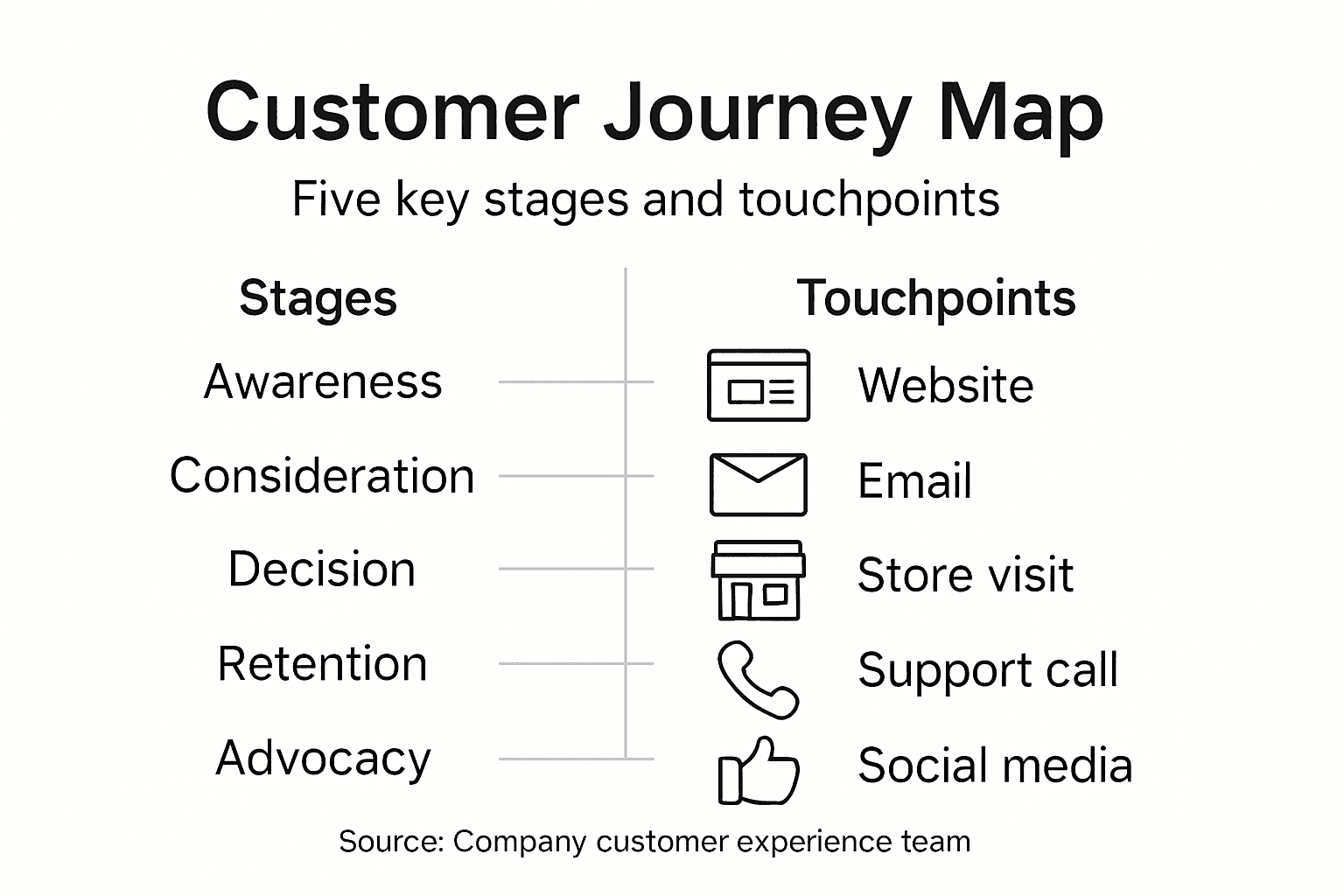
You can categorise customer journey touchpoints by their value and integration level:
| Touchpoint Type | Value for Customer | Integration Difficulty | Best Practice Example |
|---|---|---|---|
| Digital | Convenience and speed | Moderate | Unified online account access |
| Physical | Personal connection | High | Consistent in-store experience |
| Indirect | Social proof | Low | Monitoring review platforms |
Pro tip: Conduct regular customer feedback sessions and use analytics tools to continuously refine and update your customer journey touchpoint map.
Optimising for Engagement and Conversion
Customer engagement represents the crucial bridge between initial interest and lasting brand loyalty. Strategic optimization techniques enable businesses to transform casual interactions into meaningful, conversion-driving experiences.
Key strategies for improving engagement and conversion include:
-
Personalization
- Tailored content recommendations
- Customised communication
- Individual user experience design
-
Seamless Communication
- Consistent messaging across channels
- Responsive customer support
- Clear, timely information delivery
-
Friction Reduction
- Simplified navigation paths
- Intuitive user interfaces
- Minimal registration processes
- Quick problem resolution
Successful engagement transforms potential customers from passive observers into active participants in your brand’s narrative.
Cross-channel conversion optimization requires a holistic approach that connects digital and physical touchpoints. By understanding customer behaviours and preferences, businesses can create targeted strategies that guide users smoothly through their journey.
Modern conversion strategies go beyond traditional sales tactics. They focus on building genuine relationships, providing value, and creating experiences that resonate emotionally with customers. This means anticipating needs, addressing potential concerns, and consistently demonstrating your brand’s unique value proposition.
Pro tip: Implement continuous feedback loops and analytics tracking to dynamically adapt your engagement strategies based on real-time customer insights.
Common Pitfalls and Best Practices
Customer journey management demands strategic awareness of potential challenges and proven methodological approaches. Systematic research reveals critical insights into navigating complex customer experience landscapes.
Common pitfalls businesses encounter include:
-
Data Collection Errors
- Fragmented customer insights
- Inconsistent data tracking
- Siloed information across departments
- Insufficient cross-channel integration
-
Mapping Methodology Problems
- Overgeneralised customer personas
- Lack of qualitative research depth
- Ignoring emotional journey components
- Static journey representations
-
Strategic Implementation Failures
- Misaligned organizational goals
- Poor cross-functional collaboration
- Inflexible customer experience frameworks
- Neglecting continuous improvement
Effective customer journey management requires a dynamic, holistic approach that balances data-driven insights with human-centric design.
Comprehensive journey optimization demands continuous monitoring, cross-functional engagement, and adaptable strategies. Successful businesses develop flexible frameworks that can rapidly respond to changing customer behaviours and emerging market trends.
Best practices emphasise creating integrated, empathetic approaches that prioritise customer perspectives. This means developing robust data collection methods, maintaining open communication channels, and consistently refining customer experience strategies based on actionable insights.
Pro tip: Implement quarterly customer journey mapping workshops involving representatives from every department to ensure comprehensive, collaborative strategy development.
Unlock Your Customer Journey Potential with Expert Digital Solutions
Understanding the complexities of the customer journey is key to transforming casual website visits into lasting brand loyalty. The challenges of mapping multi-stage experiences, identifying friction points, and creating personalised engagement strategies need tailored digital solutions that put your customers first. Kickass Online specialises in bridging these critical stages by crafting high-converting websites designed to guide your audience seamlessly from awareness to advocacy. Whether you struggle with retaining customers or maximising conversions, our expert team ensures your digital presence reflects every step of your customer’s unique journey.
Take action today and partner with a digital marketing agency that values dedicated attention through bespoke web development, SEO, and maintenance customised for your business goals. Explore how we integrate seamless communication and friction reduction tactics to elevate your customer engagement at Kickass Online. Book your consultation now and start turning customer interactions into powerful growth opportunities tailored specifically for small and medium-sized businesses. Learn more about our website design expertise and begin optimising your customer journey with results-driven digital strategies.
Frequently Asked Questions
What is a customer journey?
A customer journey refers to the complete sequence of interactions and experiences a customer has with a business, from initial awareness through to potential loyalty and advocacy.
Why is understanding the customer journey important for businesses?
Understanding the customer journey helps businesses optimise customer experiences, build trust, and foster long-term loyalty by addressing customer needs and preferences at every interaction point.
What are the key stages of the customer journey?
The key stages of the customer journey typically include awareness, consideration, decision, retention, and advocacy, each representing a critical phase in the customer’s interaction with a brand.
How can businesses improve their customer journey mapping?
Businesses can improve customer journey mapping by regularly conducting workshops to refine insights, developing detailed customer personas, and continuously gathering feedback to identify friction points and opportunities for personalisation.
Recommended
- User Experience – Why It Shapes Online Success | Kickass Online
- Digital Consumer Behavior: A Key to Growing Your Business
- What Is UX Design and Its Impact on Business Success | Kickass Online
- Achieving a Seamless Omnichannel Marketing Experience for SMEs
- How to Identify your Ideal Customer - Ahead of Sales


Book A Discovery Call
Stay Connected