How to Create Effective Landing Pages for Higher Conversions

Finding the right formula for landing pages can feel like guesswork when every click counts for your Milton Keynes e-commerce business. Understanding your audience and setting clear goals is the foundation for meaningful conversions that support long-term growth. This guide shows how to use precise audience targeting strategies and persuasive copy to create landing pages that resonate with the customers you want to reach, setting you apart in a competitive market.
Table of Contents
- Step 1: Identify Your Target Audience And Set Clear Goals
- Step 2: Craft Persuasive Headlines And Engaging Copy
- Step 3: Design Visually Appealing And User-Friendly Layouts
- Step 4: Incorporate Strong Calls To Action And Trust Signals
- Step 5: Test, Analyse, And Optimise Page Performance
Quick Overview
| Essential Message | Detailed Explanation |
|---|---|
| 1. Define Your Audience and Goals | Know your target audience and set clear, measurable goals to guide your landing page strategy effectively. |
| 2. Craft Compelling Headlines and Copy | Use persuasive headlines and engaging content that highlight benefits, solve problems, and encourage immediate action. |
| 3. Design User-Friendly Layouts | Create visually appealing layouts with clear hierarchies and responsive designs to enhance user experience and engagement. |
| 4. Incorporate Trust Signals and CTAs | Utilise trust signals like testimonials and security badges while implementing strong calls to action to boost conversions. |
| 5. Continuously Test and Optimise | Regularly test various elements, analyse performance, and make data-driven adjustments to improve your landing page’s effectiveness. |
Step 1: Identify your target audience and set clear goals
Creating a successful landing page begins with understanding precisely who you want to reach and what specific outcomes you aim to achieve. This critical first step determines everything that follows in your conversion strategy.
To effectively identify your target audience, start by developing detailed user personas that go beyond basic demographics. The process of creating detailed user personas involves comprehensive research into your potential customers’ characteristics:
- Demographic details: Age, location, income level
- Professional background: Industry, job role, career stage
- Behavioural insights: Online browsing habits, purchasing patterns
- Pain points: Specific challenges your product or service might solve
- Motivational triggers: What drives their decision-making
Next, establish clear and measurable goals for your landing page. These objectives should be specific, quantifiable, and directly aligned with your broader business strategy. Consider goals such as:
Here is a summary of key landing page goals and their potential business impacts:
| Landing Page Goal | Example Outcome | Business Impact |
|---|---|---|
| Generate qualified leads | 50 new sign-ups per month | Expands sales pipeline |
| Achieve high conversion rate | 20% visitor-to-customer ratio | Improves marketing ROI |
| Capture email addresses | 200 new subscribers weekly | Supports ongoing engagement |
| Drive demo or product requests | 30 demo bookings monthly | Increases direct sales chances |
- Generating a specific number of qualified leads per month
- Achieving a target conversion rate
- Capturing email addresses for future marketing
- Driving product sign-ups or demo requests
By combining precise audience targeting strategies with well-defined objectives, you create a foundation for a landing page that speaks directly to your ideal customers’ needs and motivations.
Successful landing pages are not about attracting everyone, but about connecting meaningfully with the right audience.
Expert tip: Regularly update your user personas and landing page goals based on actual performance data and customer feedback to maintain relevance and effectiveness.
Step 2: Craft persuasive headlines and engaging copy
Creating compelling landing page content is an art form that requires strategic thinking and psychological insight. Your headline and copy are the critical elements that will either capture your audience’s attention or send them clicking away.
To develop persuasive writing strategies, start by understanding the core principles of engaging communication. Your headline must instantly communicate value and trigger an emotional response:
- Highlight a specific benefit: Focus on what your audience will gain
- Use powerful, action-oriented language: Verbs that create excitement
- Address a specific pain point: Show you understand their challenges
- Create a sense of urgency: Motivate immediate action
- Keep it concise and clear: Avoid jargon and complicated language
When crafting your landing page copy, implement these key techniques:
- Open with a strong, problem-solving statement
- Use social proof like testimonials or case studies
- Break complex information into digestible chunks
- Emphasise unique value propositions
- Maintain a conversational, direct tone
The techniques for developing persuasive arguments/08%3A_Writing_to_Persuade/8.07%3A_Tips_for_Writing_Academic_Persuasive_Essays) apply directly to landing page copywriting, focusing on logical structure and emotional engagement.
Great landing page copy doesn’t just describe - it connects, convinces, and compels action.
Expert tip: Always draft multiple headline variations and test them with your target audience to discover which resonates most powerfully.
Step 3: Design visually appealing and user-friendly layouts
Crafting a landing page layout that captivates and converts requires strategic design thinking that balances aesthetic appeal with functional clarity. Your visual design is the silent communicator that guides users towards taking action.
When developing your layout, focus on web design principles that enhance usability and create an intuitive user experience:
- Maintain clean, uncluttered spaces: Avoid overwhelming visitors
- Use consistent colour schemes: Align with your brand identity
- Implement clear visual hierarchy: Guide the user’s eye naturally
- Ensure sufficient colour contrast: Improve readability for all users
- Create responsive design: Adapt seamlessly across different devices
Consider these key layout strategies to maximise user engagement:
- Position your primary call-to-action prominently
- Use whitespace strategically to highlight important elements
- Select fonts that are easy to read on multiple devices
- Limit the number of form fields
- Incorporate visual storytelling through strategic imagery
Understanding different web design layout types allows you to choose the most effective structure for your specific landing page goals.
An exceptional landing page layout transforms visitors from passive observers to active participants.
Expert tip: Conduct regular user testing to validate your layout’s effectiveness and be prepared to iterate based on real user feedback.

Step 4: Incorporate strong calls to action and trust signals
Transforming landing page visitors into committed customers requires a strategic blend of compelling calls to action and persuasive trust signals. Your goal is to remove hesitation and create a seamless path towards conversion.
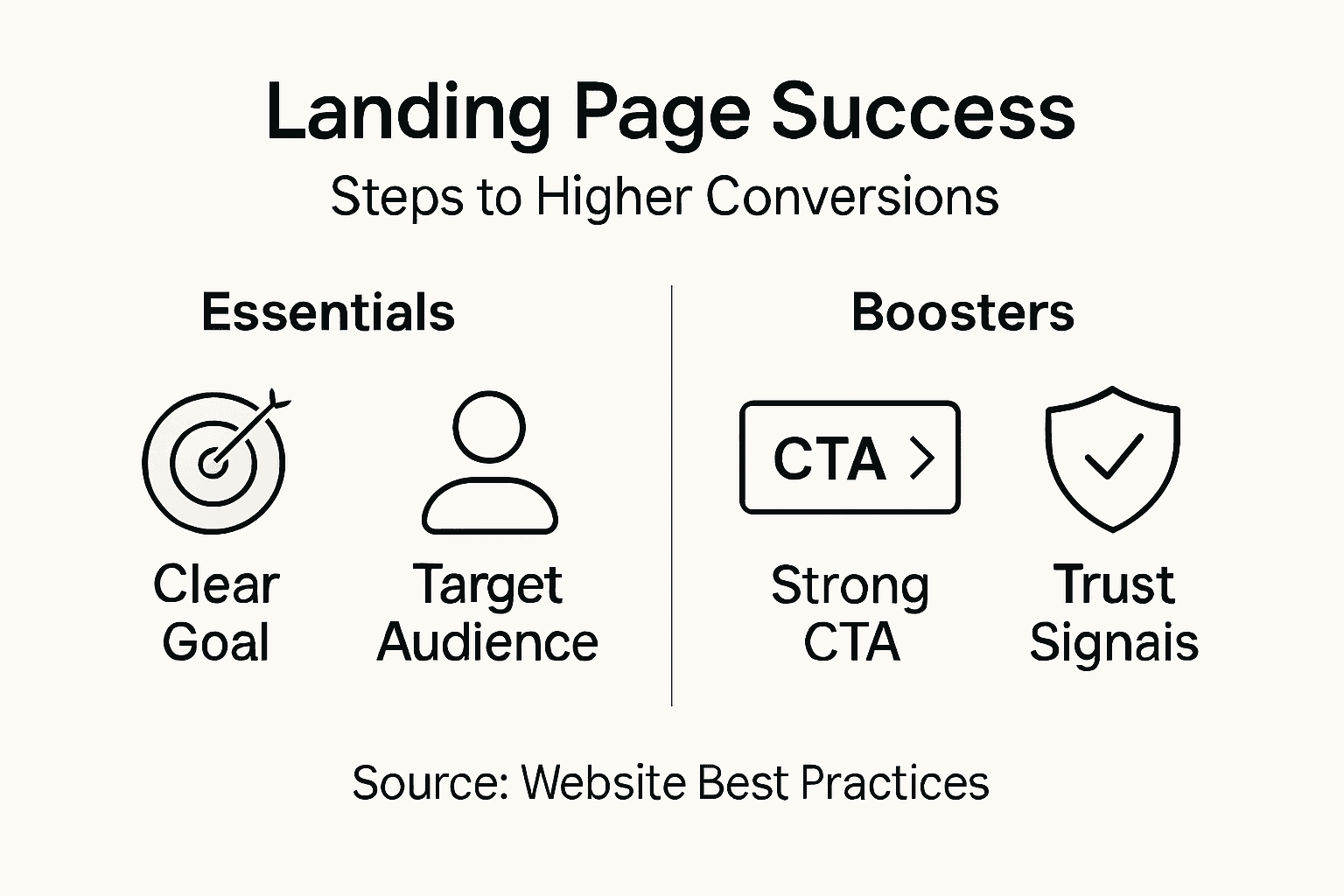
Start by understanding critical trust indicators that reassure potential customers about your credibility:
The following table compares trust signals and their unique effects on landing page credibility:
| Trust Signal | How It Reassures Visitors | Business Benefit |
|---|---|---|
| Client testimonials | Shows social approval | Builds confidence |
| Certifications & badges | Demonstrates expertise | Enhances reputation |
| Security badges | Guarantees visitor safety | Reduces conversion barriers |
| Media mentions | Provides third-party validation | Establishes authority |
| Visible contact information | Increases transparency | Boosts customer trust |
- Display client testimonials: Real stories from satisfied customers
- Show professional certifications: Validate your expertise
- Include security badges: Demonstrate website safety
- Highlight media mentions: Showcase third-party validation
- Provide transparent contact information: Build confidence through accessibility
When crafting your calls to action, focus on these key principles:
- Use action-oriented, urgent language
- Make buttons visually prominent
- Create clear value propositions
- Position calls to action strategically
- Offer low-risk engagement options
Carefully implementing digital trust elements and conversion strategies can dramatically improve user engagement and conversion rates.
A powerful call to action doesn’t just invite action - it removes all barriers to saying yes.
Expert tip: A/B test different call to action phrasings and designs to discover what resonates most powerfully with your specific audience.
Step 5: Test, analyse, and optimise page performance
Transforming your landing page from good to exceptional requires continuous testing, meticulous analysis, and data-driven optimisation. Your goal is to create a dynamic, high-performing page that consistently delivers superior conversion rates.
Web performance fundamentals reveal critical insights into creating a seamless user experience:
- Monitor page load times: Reduce potential user drop-offs
- Track user interaction metrics: Understand engagement patterns
- Analyse conversion funnel: Identify potential friction points
- Measure bounce rates: Evaluate content effectiveness
- Compare different design variations: Use A/B testing systematically
Implement a comprehensive performance optimisation strategy through these steps:
- Set up robust analytics tracking
- Conduct regular performance audits
- Test across multiple devices and browsers
- Collect and analyse user behaviour data
- Make incremental, data-supported improvements
Understanding performance optimization techniques helps transform small improvements into significant conversion gains.
Continuous testing isn’t about perfection - it’s about persistent, incremental enhancement.
Expert tip: Invest in professional analytics tools that provide deep, actionable insights beyond surface-level metrics.
Boost Your Conversion Rates with Expert Landing Page Solutions
Creating an effective landing page that converts visitors into loyal customers requires more than just good design. This article highlights common challenges such as targeting the right audience, crafting persuasive copy, and integrating strong calls to action. If you are struggling with building a landing page that truly resonates or lacks clear goals like generating leads and building trust signals, you are not alone. Achieving high conversion rates depends on aligning your website’s purpose with user behaviour and optimising every element from headlines to layout.
At Kickass Online, we specialise in delivering personalised landing pages designed to captivate your specific audience and drive measurable results. Our team applies proven strategies for user personas, engaging copywriting, and optimised layouts that reflect your brand identity. Explore our tailored Websites services and discover how our dedicated experts incorporate trust signals and compelling calls to action that encourage action now.
Don’t let inefficient landing pages hold back your business growth. Connect with us at Kickass Online today to book a consultation and transform visitors into conversions through strategic web development solutions that evolve with your needs.
Frequently Asked Questions
How can I identify my target audience for my landing page?
To identify your target audience, develop detailed user personas by researching demographic details, professional background, behavioural insights, pain points, and motivational triggers. Start by gathering data on your potential customers through surveys, social media analytics, and customer feedback to create a comprehensive profile that guides your content strategy.
What are some clear goals I should set for my landing page?
Set specific and measurable goals such as generating a particular number of qualified leads, achieving a target conversion rate, or capturing a specific number of email addresses. For example, aim for 50 new sign-ups per month to expand your sales pipeline and measure your success regularly to adjust your strategies as needed.
What elements should I include in persuasive headlines for my landing page?
Your headlines should highlight specific benefits, use powerful action-oriented language, address pain points, create urgency, and remain concise. Start by crafting multiple headline variations and test them with your audience to find which resonates best and drives higher engagement.
How can I design a user-friendly layout for my landing page?
To design a user-friendly landing page layout, maintain clean, uncluttered spaces, use consistent colour schemes, and implement clear visual hierarchy. Focus on positioning your primary call-to-action prominently and conducting user testing to ensure visitors can easily navigate and engage with your content.
What types of trust signals should I incorporate to improve conversions?
Include trust signals such as client testimonials, professional certifications, security badges, media mentions, and visible contact information to enhance credibility. These elements reassure visitors and can significantly improve conversion rates when strategically displayed on your landing page.
How can I analyse and optimise the performance of my landing page?
To analyse and optimise your landing page performance, monitor key metrics like page load times, user interactions, and conversion funnels. Set up robust analytics tracking and conduct regular performance audits, making data-supported improvements based on user behaviour every 30 days to enhance overall effectiveness.
Recommended
- What Is a Landing Page and Why Conversion Matters | Kickass Online
- Top 9 Strategies for Crafting High-Converting Landing Pages | Kickass Online
- 7 Elements that Influence Conversions | Kickass Online
- 5 Common Mistakes to Avoid When Designing a Landing Page | Kickass Online
- 7 Best B2B Landing Page Ideas for SaaS Founders - Kadima


Book A Discovery Call
Stay Connected