What Is Conversion Rate and Why It Matters for SMEs
Struggling to turn more website visitors into actual customers is a challenge many British business owners face daily. Conversion rate is more than a buzzword—it is a measurable indicator of how well your online efforts work to increase sales and grow revenue. By focusing on tracking and improving this vital percentage, you gain clear insights into where your digital marketing and web design can deliver real business results.
Table of Contents
- Defining Conversion Rate In Digital Marketing
- Types Of Conversions: Macro Vs Micro Actions
- How To Calculate And Track Conversion Rates
- Common Pitfalls And How To Avoid Them
- Optimising Conversion Rate For Business Growth
Key Takeaways
| Point | Details |
|---|---|
| Understanding Conversion Rates | Conversion rates measure the percentage of website visitors who complete a desired action, guiding businesses to refine their digital strategies. |
| Types of Conversions | Macro conversions are high-value actions contributing to immediate business goals, while micro conversions indicate user interest and potential future actions. |
| Track and Optimise | Regularly track conversion metrics to identify patterns and opportunities for improvement, using A/B testing and user behaviour analysis. |
| Avoid Common Pitfalls | Focus on user experience and clear messaging to avoid common mistakes that undermine conversion rates, ensuring a smooth pathway for user engagement. |
Defining Conversion Rate in Digital Marketing
A conversion rate represents the critical percentage of website visitors who complete a specific desired action, such as making a purchase or submitting a contact form. Digital marketing metrics reveal this performance indicator tracks how effectively your online presence transforms casual browsers into engaged customers.
Understanding conversion rates requires breaking down the fundamental calculation:
- Number of visitors completing an action
- Total number of website visitors
- Percentage calculated by: (Conversions ÷ Total Visitors) × 100
These metrics aren’t merely statistical abstractions - they’re direct indicators of marketing effectiveness. Conversion rates demonstrate how compelling your website design, content, and user experience are at motivating potential customers to take meaningful actions.

For small and medium enterprises (SMEs), tracking conversion rates provides invaluable insights into digital strategy performance. Website conversion performance helps businesses understand which marketing channels, landing pages, and promotional strategies generate the most tangible results.
Pro tip: Track your conversion rates monthly and identify patterns in customer behaviour to continuously refine your digital marketing approach.
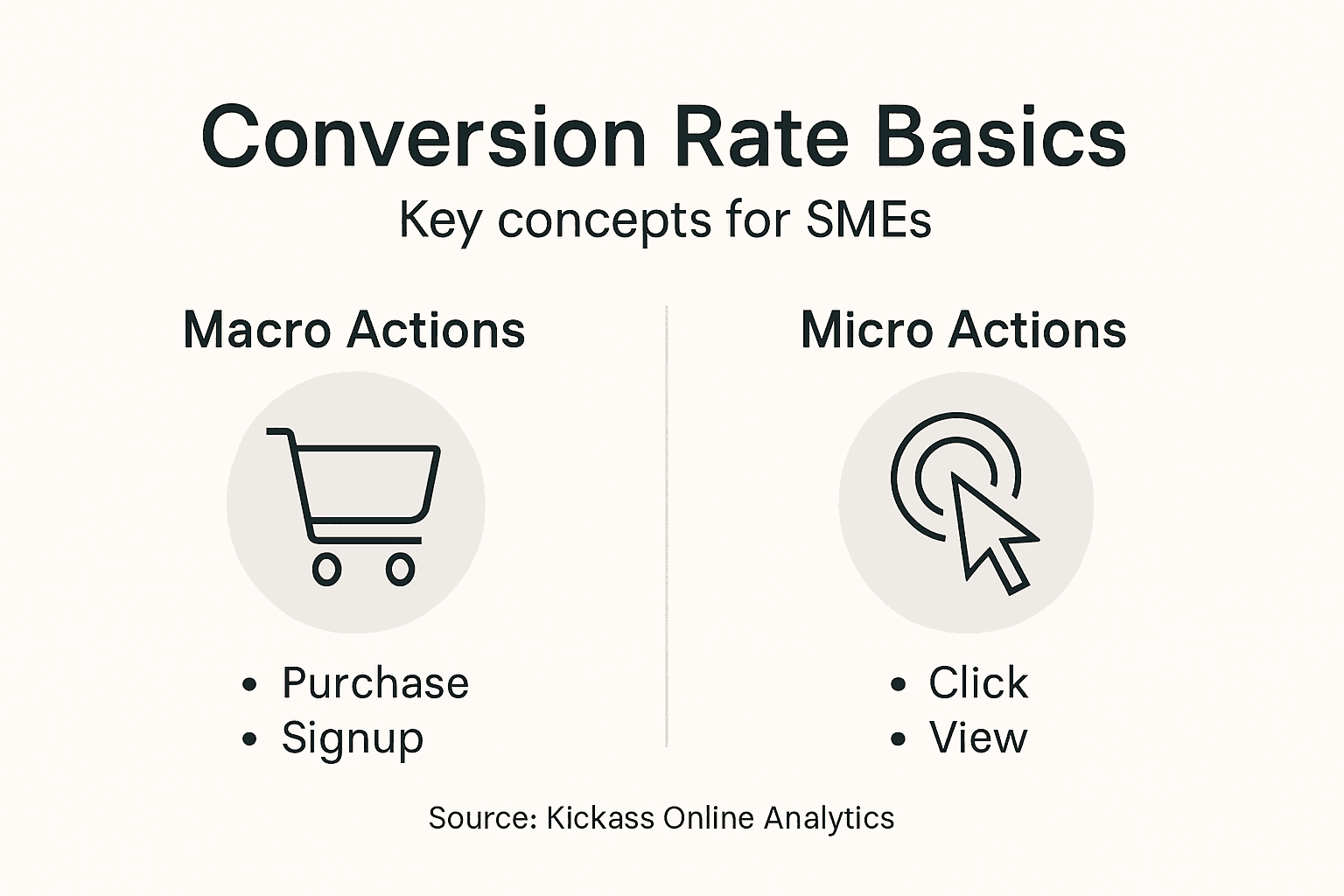
Types of Conversions: Macro vs Micro Actions
Conversion actions in digital marketing are strategically categorised into two essential types: macro and micro conversions. Business objectives distinguish these different user engagement levels, providing a nuanced approach to understanding customer interactions.
Macro conversions represent the primary, high-value actions that directly contribute to business goals:
- Completed product purchases
- Service subscriptions
- Request for sales consultations
- Signed contracts
- Direct product bookings
Micro conversions, by contrast, are smaller supporting interactions that demonstrate user interest and potential future engagement:
- Newsletter sign-ups
- Product page views
- Video content watches
- Downloading marketing resources
- Adding items to shopping cart
- Following social media channels
Understanding the relationship between macro and micro conversions allows businesses to create more sophisticated tracking and nurturing strategies. These incremental interactions provide crucial insights into customer behaviour, helping organisations design more effective conversion pathways.
By mapping both macro and micro conversion points, small and medium enterprises can develop a comprehensive view of their customer journey, identifying potential friction points and optimising each stage of user interaction.
The following table contrasts macro and micro conversions for a clearer strategic overview:
| Conversion Type | Core Focus | Impact on Business Goals |
|---|---|---|
| Macro Conversion | Direct revenue actions | Immediate contribution to growth |
| Micro Conversion | Supporting engagement | Signals interest for future opportunities |
Pro tip: Track micro conversions as leading indicators of potential macro conversion opportunities, using these smaller interactions to refine your marketing approach.
How to Calculate and Track Conversion Rates
Calculating conversion rates is a straightforward yet powerful method for understanding digital marketing performance. Digital marketing analytics provide businesses with a precise formula to measure user engagement: (Number of Conversions ÷ Total Visitors) × 100 = Conversion Rate Percentage.
To effectively track conversion rates, small and medium enterprises should focus on several key metrics:
- Total website visitors
- Number of completed desired actions
- Conversion rate percentage
- Conversion value
- Cost per conversion
Most businesses utilise web analytics platforms to monitor these crucial metrics. Marketing experimentation strategies enable continuous improvement through systematic testing, including:
- A/B testing website elements
- Analysing user behaviour flows
- Identifying conversion barriers
- Optimising landing page designs
- Tracking micro and macro conversion points
Understanding your specific conversion rate helps diagnose website performance issues and provides actionable insights for targeted improvements. By consistently monitoring these metrics, businesses can make data-driven decisions that directly impact revenue and growth.
Companies should aim to benchmark their conversion rates against industry standards while recognising that optimal rates vary significantly across different sectors and business models.
Pro tip: Set up conversion tracking in your analytics platform and review performance monthly, focusing on incremental improvements rather than dramatic overnight changes.
Common Pitfalls and How to Avoid Them
Conversion rate optimisation demands a strategic approach that goes beyond simple campaign modifications. Marketing campaign effectiveness relies on understanding and avoiding common strategic mistakes that can undermine digital marketing performance.
Key conversion rate pitfalls for small and medium enterprises include:
- Neglecting user experience design
- Insufficient website loading speeds
- Poor mobile responsiveness
- Complicated conversion paths
- Weak value proposition messaging
- Inconsistent call-to-action strategies
Businesses frequently make critical errors in their conversion strategies that dramatically impact performance. These mistakes often stem from:
- Overcomplicating website navigation
- Failing to understand target audience needs
- Using generic, non-personalised content
- Ignoring technical website performance issues
- Lack of clear, compelling value propositions
Understanding these pitfalls requires a holistic approach to digital marketing. Successful conversion rate optimisation involves continuous testing, refinement, and a deep understanding of user behaviour patterns. Small businesses must remain adaptable, using data-driven insights to make incremental improvements.
Conversion rate success depends more on understanding user experience than implementing complex marketing tactics.
Pro tip: Conduct monthly user experience audits, focusing on simplifying conversion paths and addressing potential friction points in your website design.
Optimising Conversion Rate for Business Growth
Conversion rate optimisation requires a sophisticated, multi-disciplinary approach that goes far beyond simple marketing tactics. Advanced optimization strategies integrate psychology, technology, and data analytics to transform digital marketing performance.
For small and medium enterprises, effective conversion optimization involves several critical strategies:
- Personalising user experiences
- Implementing targeted messaging
- Reducing website friction points
- Leveraging behavioural economics insights
- Creating compelling value propositions
- Developing trust-building elements
Digital marketing touchpoints play a crucial role in driving conversion success. SMEs must focus on:
- Optimising online advertising campaigns
- Improving search engine visibility
- Enhancing social media engagement
- Managing customer review strategies
- Creating consistent cross-channel experiences
Successful conversion rate optimization demands a holistic approach that balances technological innovation with deep psychological understanding. By combining data-driven insights with strategic user experience design, businesses can create more effective digital marketing ecosystems.
Here is a summary of advanced strategies and their influence on conversion rates:
| Strategy | Description | Expected Business Impact |
|---|---|---|
| Personalised User Experiences | Tailoring content to user profiles | Higher engagement rates |
| Behavioural Economics Insights | Using decision triggers and nudges | Increased conversion rates |
| Cross-Channel Consistency | Unified messaging across platforms | Improved brand trust |
| Trust-Building Elements | Adding reviews, certifications | Enhanced customer confidence |
Sustainable business growth emerges from understanding and addressing customer needs at every interaction point.
Pro tip: Implement a continuous experimentation framework, testing one strategic element at a time to incrementally improve conversion performance.
Maximise Your Conversion Rate with Expert Digital Solutions
Understanding the vital role of conversion rates is the first step towards growing your small or medium-sized business effectively. If you are facing challenges such as low engagement, complicated conversion paths, or poor website performance—as highlighted in the article—it is crucial to address these pain points with professional guidance. Concepts like optimising macro and micro conversions, improving user experience, and personalised marketing strategies are essential for turning website visitors into loyal customers.
Kickass Online specialises in building high-converting websites and delivering tailored services such as expert website design, robust SEO optimisation, and reliable ongoing website maintenance to enhance your digital presence. Our limited client intake means we provide dedicated attention to your unique business needs, helping you overcome common pitfalls like slow loading times and weak calls to action.

Ready to elevate your conversion rate and unlock sustained growth? Discover how our comprehensive digital marketing solutions at Kickass Online can transform your customer journey. Book a consultation now and take the confident step towards a website that truly converts visitors into customers.
Frequently Asked Questions
What is a conversion rate in digital marketing?
A conversion rate is the percentage of website visitors who complete a desired action, such as making a purchase or signing up for a newsletter. It is calculated by dividing the number of conversions by the total number of visitors and multiplying by 100.
Why is tracking conversion rate important for SMEs?
Tracking conversion rates allows small and medium enterprises to understand the effectiveness of their marketing strategies and website performance. It provides insights into which channels and tactics drive meaningful customer engagement and revenue growth.
What are macro and micro conversions?
Macro conversions are high-value actions, such as completed purchases or service subscriptions, that directly contribute to business goals. Micro conversions are smaller interactions like newsletter sign-ups or product page views that indicate user interest and potential future engagement.
How can SMEs optimise their conversion rates?
SMEs can optimise conversion rates by personalising user experiences, implementing targeted messaging, reducing website friction points, and continuously testing and refining their marketing strategies based on user behaviour patterns.
Recommended
- 10 Good Reasons to Care About Conversion Rates | Kickass Online
- Supercharge Your SME’s Sales Potential with Conversion Rate Optimisation Strategies | Kickass Online
- 5 Effective Tips to Improve Website Conversion Rate | Kickass Online
- Demystifying Conversion Rate Optimisation: A Comprehensive Guide for SME Success | Kickass Online
- Substock : Calculer le ROI


Book A Discovery Call
Stay Connected