How to Optimise Website Content for Higher Conversions

Over 90 percent of british consumers research products online before making a purchase. For business owners in Milton Keynes, a strong website is no longer a luxury but a necessity for reaching potential customers and staying ahead of competitors. This guide breaks down proven strategies for transforming your website into a high converting platform, showing you how targeted SEO and content enhancements can drive measurable growth.
Table of Contents
- Step 1: Conduct a Comprehensive Website Audit
- Step 2: Research and Select Target Keywords
- Step 3: Craft Engaging and Relevant Content
- Step 4: Enhance On-Page Elements for SEO
- Step 5: Improve User Experience and Accessibility
- Step 6: Measure, Analyse and Refine Performance
Quick Summary
| Main Insight | Explanation |
|---|---|
| 1. Conduct Regular Audits | Perform quarterly website audits to identify performance issues and areas for improvement. |
| 2. Focus on Target Keywords | Regularly refresh keyword strategies to attract the right audience and improve search visibility. |
| 3. Craft Engaging Content | Create content that addresses audience needs with clarity and invites them to take action. |
| 4. Optimise On-Page SEO | Refine titles, descriptions, and headers to enhance both user experience and search engine comprehension. |
| 5. Measure and Analyse Performance | Implement tracking tools to analyse user behaviour and refine website performance continuously for sustained success. |
Step 1: Conduct a Comprehensive Website Audit
A comprehensive website audit provides an essential diagnostic roadmap for understanding your online performance. By systematically evaluating your website’s technical infrastructure, content quality, and user experience, you can uncover hidden opportunities for improvement and conversion optimisation.
Begin your audit by examining key performance indicators across multiple dimensions. Detailed performance analysis requires a methodical approach that covers technical SEO, content effectiveness, user experience, and security. Start with technical elements such as page loading speed, mobile responsiveness, and site architecture. Check for broken links, assess crawlability for search engines, and review your website’s overall structural integrity.
Move next to content evaluation. Analyse each page’s relevance, keyword optimisation, and alignment with user intent. Examine metrics like bounce rates, time on page, and conversion rates to understand how effectively your content engages visitors. Look for gaps in your content strategy and identify pages that might require refreshing or complete rewrites to better serve your audience’s needs.
Expert Tip: Conduct your website audit quarterly to stay ahead of performance challenges and maintain a competitive digital presence.
Here’s a summary of key website audit focus areas and their business benefits:
| Audit Area | What It Covers | Business Impact |
|---|---|---|
| Technical SEO | Speed, crawlability, site structure | Improves visibility, reduces errors |
| Content Effectiveness | Relevance, keywords, user intent | Boosts engagement, drives leads |
| User Experience | Navigation, layout, accessibility | Increases retention, lowers bounce rate |
| Security | SSL, data protection, safe connections | Builds trust, prevents breaches |
Step 2: Research and Select Target Keywords
Keyword research is the strategic foundation for attracting potential customers and improving your website’s search engine visibility. Your goal is to identify precise search terms that align perfectly with your target audience’s needs and your business objectives.

Begin by understanding user search intent through comprehensive brainstorming and analysis. Generate an initial list of potential keywords by considering the questions your ideal customers might ask, the problems they need solved, and the language they typically use when searching online. Utilise keyword research tools to expand your list and uncover related search terms, paying close attention to metrics like search volume and competition levels. Focus on long-tail keywords that capture more specific user queries, as these often indicate stronger purchase intent and typically have less competitive ranking environments.
Narrow down your keyword selection by evaluating commercial potential and relevance. Prioritise keywords that demonstrate clear alignment with your business offerings, have reasonable search volumes, and present achievable competition levels. Cross reference your selected keywords with your website’s content strategy, ensuring you can create meaningful, valuable content that genuinely addresses user needs.
Expert Tip: Regularly refresh your keyword strategy every three to six months to stay aligned with evolving search trends and user behaviours.
Compare different keyword strategies to understand their advantages:
| Keyword Type | Description | Business Benefit |
|---|---|---|
| Short-tail | 1-2 word, broad search terms | Higher traffic, more competition |
| Long-tail | 3+ word, specific intent | Better conversion, lower competition |
| Branded | Includes company/product name | Drives qualified leads |
Step 3: Craft Engaging and Relevant Content
Crafting compelling content requires a strategic approach that connects directly with your target audience’s needs, interests, and pain points. Your goal is to create meaningful communication that not only attracts readers but also motivates them to take action.
Begin by mapping your content to the specific keywords and user intent you identified earlier. Content marketing strategies should focus on addressing your audience’s core challenges while demonstrating your unique expertise. Develop content that provides genuine value through practical insights, actionable advice, and clear solutions. Structure your writing with a conversational tone that feels personal and accessible, using clear language that speaks directly to your reader’s experience. Break down complex ideas into digestible sections, utilise subheadings, and incorporate visual elements like bullet points or graphics to enhance readability and engagement.
Ensure your content maintains a consistent voice that reflects your brand’s personality while remaining authentically helpful. Balance informative detail with emotional connection, showing that you understand your audience’s specific needs and can provide meaningful support. Integrate relevant examples, case studies, or personal anecdotes that make your content more relatable and compelling, transforming technical information into a narrative that resonates with your readers.
Expert Tip: Always write from your audience’s perspective, focusing on their challenges and potential solutions rather than simply promoting your services.
Step 4: Enhance On-Page Elements for SEO
Optimising your website’s on-page elements is crucial for improving search engine visibility and attracting potential customers. Your objective is to fine tune each page to communicate effectively with both search engines and human readers.
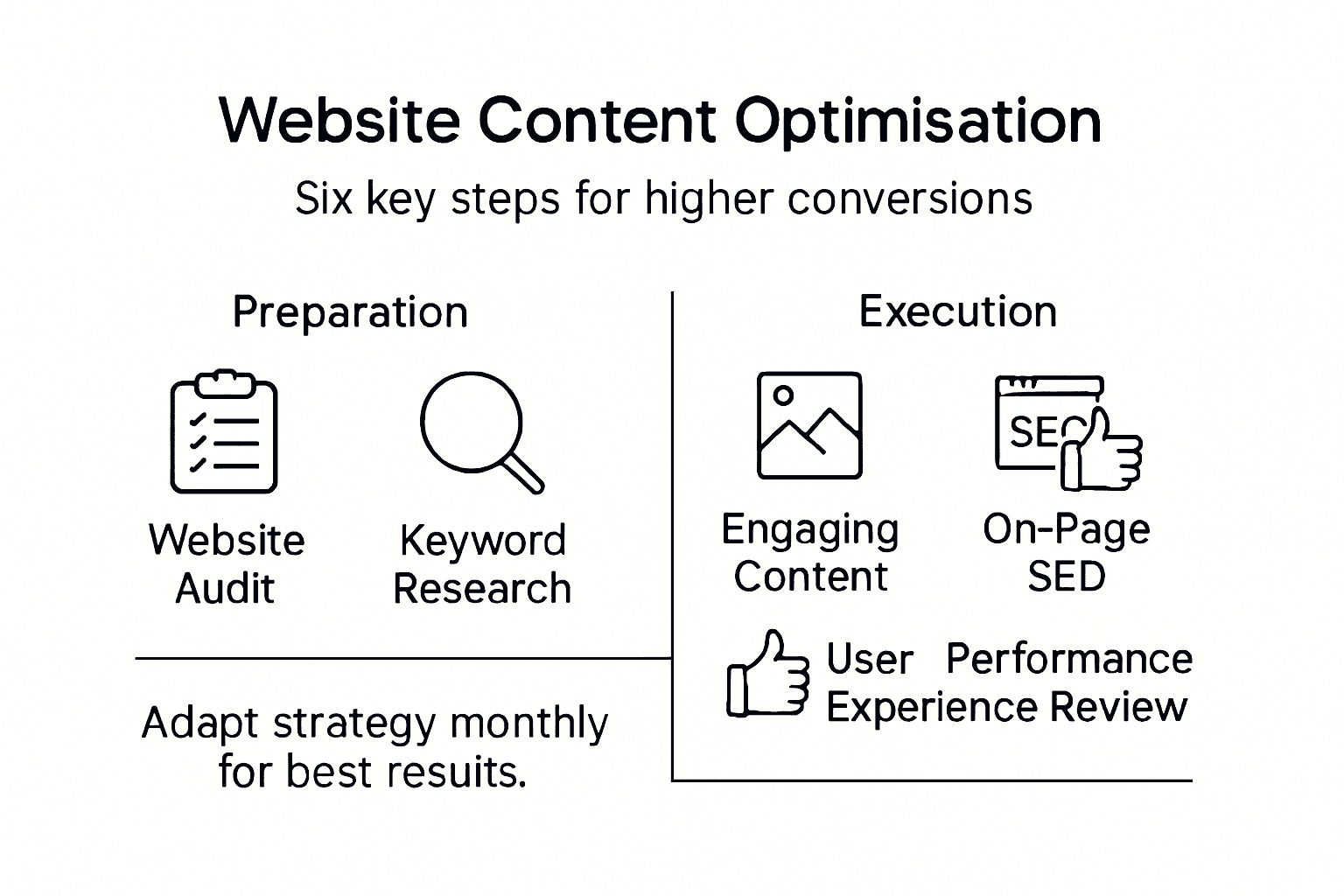
On-page SEO strategies require meticulous attention to multiple technical and content-related factors. Start by refining your page titles and meta descriptions to precisely reflect your content while incorporating target keywords naturally. Create clear concise headers that break down information logically H1 tags should capture the primary page topic while subsequent headers H2 and H3 provide structured navigation through your content. Optimise your URLs to be clean readable and keyword relevant avoiding unnecessary parameters or complex strings that confuse both users and search algorithms.
Prioritise technical performance alongside content quality. Ensure your website loads quickly across all devices with particular emphasis on mobile responsiveness. Implement structured data markup to help search engines understand your content context more accurately. Include internal links that connect related content strategically guiding visitors through a logical information pathway and signalling content relationships to search engine crawlers. Remember that every on-page element should serve dual purposes enhancing both user experience and search engine comprehension.
Expert Tip: Regularly test your page performance using professional SEO analysis tools to identify and address potential optimisation opportunities.
Step 5: Improve User Experience and Accessibility
Enhancing user experience and digital accessibility transforms your website from a mere online presence into an engaging platform that welcomes and serves all potential visitors. Your mission is to create an inclusive digital environment that seamlessly connects with diverse user needs and expectations.
Start by improving user experience design with a laser focus on navigation clarity and intuitive interface elements. Conduct thorough accessibility assessments that ensure your website remains usable for individuals with varying technological capabilities and potential physical limitations. This means implementing clear colour contrast, enabling keyboard navigation, providing alternative text for images, and designing responsive layouts that adapt smoothly across different devices and screen sizes. Consider users who might rely on screen readers or assistive technologies and structure your content to be easily interpretable by these systems.
Prioritise responsive design principles that create consistent experiences across mobile phones, tablets, and desktop computers. Pay careful attention to loading speeds, minimise complex navigation structures, and create clear visual hierarchies that guide users naturally through your content. Include descriptive link texts, use semantic HTML structures, and ensure that interactive elements are sufficiently large and well spaced to accommodate users with motor skill challenges.
Expert Tip: Test your website accessibility using professional tools and consider inviting users with diverse abilities to provide real world feedback on their experience.
Step 6: Measure, Analyse and Refine Performance
Tracking your website’s performance is a critical process that transforms raw data into actionable insights for continuous improvement. Your ultimate goal is to create a systematic approach to understanding and enhancing your digital presence.
Website performance tracking requires implementing comprehensive analytics tools that capture detailed metrics about user behaviour. Set up robust tracking mechanisms to monitor key performance indicators such as conversion rates, bounce rates, average session duration, and traffic sources. Regularly analyse these metrics to identify patterns, strengths, and potential areas for improvement. Pay close attention to user journey maps that reveal how visitors navigate through your website, pinpointing where they engage most and where they might be losing interest.
Develop a culture of continuous experimentation by implementing systematic A/B testing strategies. Create multiple versions of key website elements like landing pages, call-to-action buttons, and content layouts, then methodically test their performance. Use statistical analysis to determine which variations generate the most meaningful results. Remember that performance refinement is an ongoing process requiring patience, attention to detail, and a willingness to adapt based on empirical evidence.
Expert Tip: Schedule monthly performance reviews to ensure your website remains dynamic and responsive to changing user needs and market trends.
Unlock Higher Conversions with Expert Website Solutions
Struggling to optimise your website content for better engagement and conversions? This article highlights key challenges such as enhancing user experience, aligning keywords with user intent, and refining on-page SEO elements to boost your website’s performance. At Kickass Online, we understand these pain points deeply and offer personalised services designed to transform your digital presence through professional website design, effective SEO optimisation, and ongoing maintenance that prioritises security and speed.
Explore our comprehensive Websites category to see how we craft high-converting, user-centred websites tailored for small and medium-sized businesses. Take control of your online growth today by booking a consultation at Kickass Online and start turning your website into a powerful conversion machine. For practical tips and insights that complement your content strategy, visit our Tutorials section and stay ahead in the digital marketplace.
Frequently Asked Questions
How can I conduct a comprehensive website audit to optimise content for higher conversions?
A comprehensive website audit involves evaluating key performance indicators such as technical SEO, content quality, and user experience. Start by assessing your site’s loading speed, mobile responsiveness, and structure while reviewing content engagement metrics like bounce rates and conversion rates.
What are effective ways to select target keywords for my website content?
To select effective target keywords, brainstorm questions your audience might ask and use keyword research tools to expand your list. Focus on long-tail keywords that match specific user intent, as they often lead to higher conversion rates due to less competition.
How do I craft engaging content that boosts conversions?
Craft engaging content by aligning with the keywords and user intent identified earlier, providing practical insights, and clear solutions. Structure the content with a conversational tone and include personal anecdotes or examples to connect better with your audience and drive action.
What on-page elements should I optimise for better SEO and conversions?
Optimise on-page elements like page titles, meta descriptions, and headers to incorporate target keywords naturally. Ensure your URLs are clean and readable, while also prioritising website loading speed and mobile responsiveness to enhance user experience.
How can I improve user experience on my website to increase conversions?
To improve user experience, focus on creating clear navigation and intuitive interface design. Conduct accessibility assessments to ensure users with varying abilities can navigate your site easily and adjust visual elements to enhance readability, ultimately leading to more conversions.
How do I measure and analyse my website’s performance effectively?
Measure your website’s performance by implementing analytics tools to track key performance indicators like conversion rates and bounce rates. Regularly analyse these metrics, and conduct A/B testing on various elements to refine your strategies within a set timeframe, aiming for improvement each month.
Recommended


Book A Discovery Call
Stay Connected