
What Is Google Ranking? Impact On Your Online Growth

A single change in your british website’s SEO can mean the difference between being found by customers in Milton Keynes or being lost among competitors. With over 90 percent of people starting their searches on Google, understanding how Google ranking works is crucial for any small or medium-sized business. Discover what signals matter most and how focused SEO strategies can help your business rise higher in search results and stay visible to your target audience.
Table of Contents
- Google Ranking Explained For Businesses
- Different Types Of Google Rankings Online
- Key Factors That Affect Your Search Position
- How SEO Strategies Improve Google Ranking
- Common Pitfalls And Ranking Challenges
Key Takeaways
| Point | Details |
|---|---|
| Understanding Google Ranking | Google employs complex algorithms that assess multiple factors such as content quality, relevance, and user experience to rank websites. Businesses must optimise these elements to enhance visibility. |
| Diverse Ranking Types | Different Google ranking systems exist, including organic, local, and news search, each with distinct criteria tailored to specific search contexts. Marketers should adapt strategies accordingly. |
| Search Position Influencers | Key factors affecting search rankings include content quality, technical performance, and user engagement, necessitating a focus on both high-quality content and optimised website functionality. |
| SEO Strategy Importance | Implementing effective SEO strategies, including keyword research and technical optimisation, is crucial for enhancing online visibility and improving search rankings over time. |
Google Ranking Explained For Businesses
Every business with an online presence wants to understand how Google determines which websites appear at the top of search results. Google Ranking represents a complex system where search engines evaluate and position web pages based on numerous signals and criteria. Google’s ranking systems continuously analyse hundreds of factors to determine the most relevant and valuable content for users.
The fundamental goal of Google’s ranking mechanism is delivering the most useful search results. This means websites are assessed across multiple dimensions, including content relevance, expertise, trustworthiness, and user experience. Technical aspects like page loading speed, mobile responsiveness, and site structure play critical roles in determining how prominently a website appears in search results. Businesses that understand these nuanced ranking criteria can strategically optimise their digital presence to improve visibility.
Businesses should recognise that Google’s ranking algorithms are sophisticated and dynamic. Search algorithms prioritise content that demonstrates genuine value to users, which means simply stuffing keywords or creating low-quality content will not achieve sustainable search performance. Successful digital strategies require consistently producing high-quality, authoritative content that directly addresses user needs and questions.
Pro tip: Invest time in understanding your target audience’s search intent and create content that comprehensively answers their most pressing questions, thereby naturally improving your Google ranking potential.
Different Types Of Google Rankings Online
Online ranking systems have evolved into sophisticated platforms that serve diverse purposes across various digital landscapes. Search Rankings represent complex mechanisms that evaluate and categorise content based on multiple sophisticated criteria. Different ranking systems demonstrate unique methodologies for indexing and presenting information across academic, commercial, and research domains.
In the digital ecosystem, Google offers several distinct ranking approaches tailored to specific search contexts. These include organic search rankings, which prioritise website relevance and quality, local search rankings focusing on geographical proximity and business information, and specialised rankings like Google News, Shopping, and Academic Search. Each ranking system employs intricate algorithms that analyse factors such as content quality, user engagement, website authority, and contextual relevance.
Businesses and content creators must understand that ranking systems are not monolithic but nuanced platforms designed to match user intent with the most appropriate content. The algorithms continuously evolve, incorporating machine learning and artificial intelligence to refine search results. This dynamic nature means websites must consistently produce high-quality, relevant content that genuinely addresses user queries and provides meaningful value across multiple dimensions.
Pro tip: Develop a comprehensive content strategy that targets multiple ranking signals by creating in-depth, authoritative content that serves clear user intentions across different search contexts.
Here’s a summary of Google ranking types and their unique criteria:
| Ranking Type | Main Criteria | Best Used For |
|---|---|---|
| Organic Search | Relevance, quality, authority | General website visibility |
| Local Search | Location, business details | Attracting nearby customers |
| News Search | Timeliness, accuracy, engagement | Promoting news articles |
| Shopping Search | Product relevance, pricing | E-commerce product listings |
Key Factors That Affect Your Search Position
Search Engine Ranking involves a complex interplay of multiple critical factors that determine a website’s visibility and positioning. Google’s ranking systems meticulously evaluate websites across several key dimensions, with each factor contributing differently to the overall search performance. Understanding these elements is crucial for businesses seeking to improve their online presence and attract more targeted organic traffic.
The primary factors influencing search position include content quality, technical performance, and user engagement metrics. Content relevance remains paramount, requiring websites to produce high-quality, original material that directly addresses user queries. Technical aspects such as site speed, mobile responsiveness, and secure connections play increasingly significant roles in determining search rankings. Websites must demonstrate excellent performance across devices, with fast loading times and robust security protocols that signal reliability to search algorithms.

User experience metrics have become increasingly sophisticated in determining search rankings. Search engines now analyse complex signals like user interaction time, bounce rates, and content engagement to assess a website’s value. This means businesses cannot simply optimise for keywords but must create genuinely useful, compelling content that keeps visitors interested and encourages meaningful interactions. Factors such as internal linking, clear site structure, and intuitive navigation contribute substantially to how search algorithms perceive a website’s overall quality and relevance.
Pro tip: Conduct a comprehensive website audit quarterly to identify and address technical performance issues, ensuring your site remains optimised for both user experience and search engine requirements.
How SEO Strategies Improve Google Ranking
Search Engine Optimisation represents a comprehensive approach to enhancing online visibility and improving website performance across digital platforms. Strategic SEO techniques systematically address multiple interconnected aspects of digital presence, allowing businesses to climb search engine rankings through methodical and targeted improvements.
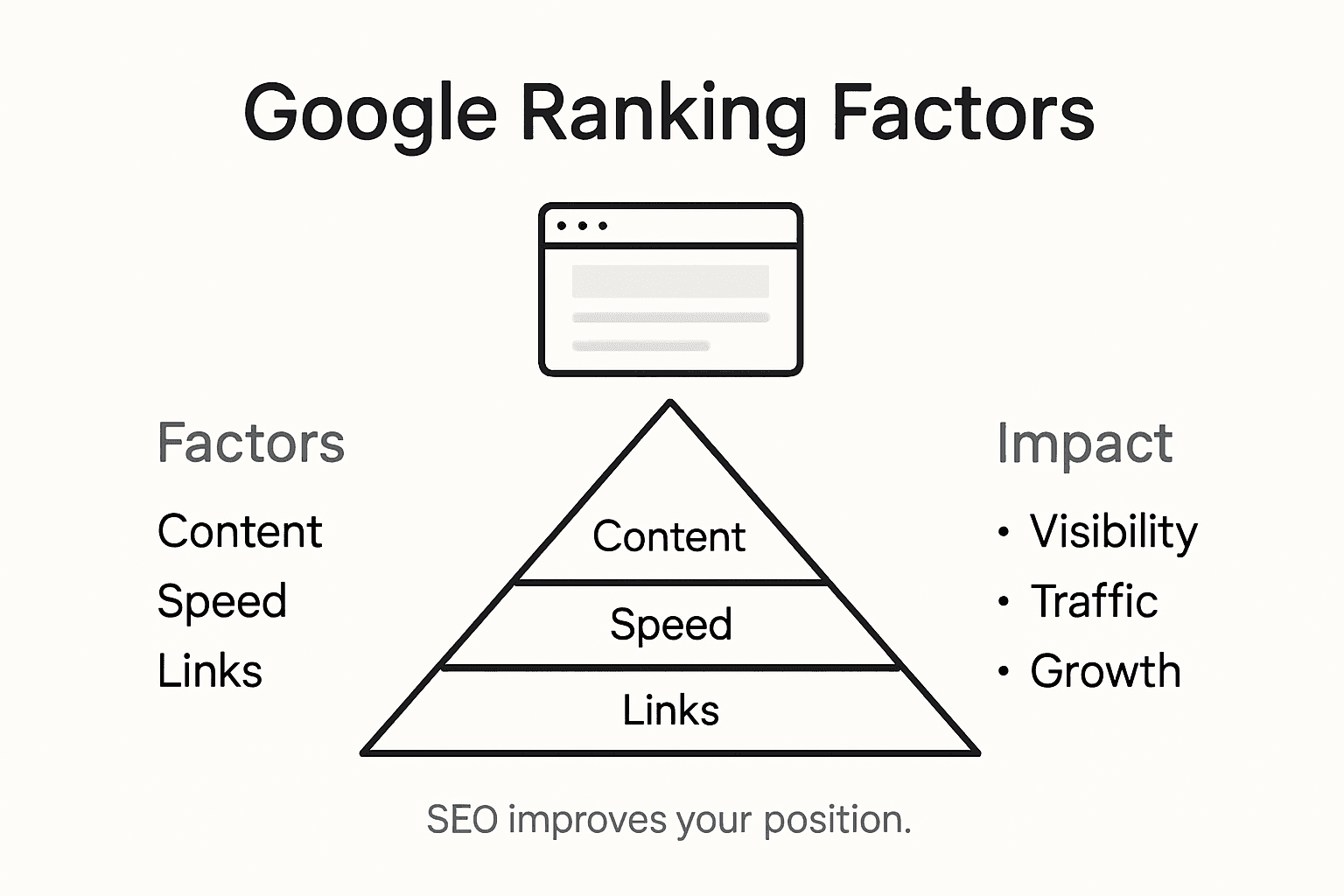
Keyword research forms the foundational element of effective SEO strategies, enabling businesses to understand and target specific user search patterns. By identifying precise search terms relevant to their industry, organisations can develop content that directly addresses user queries, signalling relevance to search algorithms. Technical optimisation complements content strategies by ensuring websites load quickly, function smoothly across devices, and provide secure, seamless user experiences. This includes optimising site architecture, improving page speed, implementing responsive design, and ensuring robust mobile compatibility.
Building online authority represents another critical dimension of SEO improvement. This involves developing high-quality backlinks from reputable websites, creating comprehensive and valuable content, and establishing digital credibility through consistent, trustworthy information sharing. Search engines increasingly prioritise websites that demonstrate expertise, authoritativeness, and reliability, meaning businesses must focus not just on technical performance but on genuine value creation for their target audiences.
Pro tip: Develop a quarterly content and technical performance audit to systematically identify and implement SEO improvements, ensuring your digital strategy remains dynamic and responsive to evolving search algorithm requirements.
See how key SEO strategies improve search rankings:
| SEO Strategy | Core Benefit | Example Impact |
|---|---|---|
| Keyword Research | Targets user intent | Higher qualified traffic |
| Technical Optimisation | Improves site performance | Faster load, less bounce rate |
| Authority Building | Enhances site credibility | More reputable backlinks |
Common Pitfalls And Ranking Challenges
Search Engine Ranking presents numerous challenges that can significantly impact a website’s online visibility and performance. Language bias in digital content indexing represents one of the most subtle yet pervasive obstacles businesses encounter when attempting to improve their search rankings across diverse digital landscapes.
One of the most common pitfalls involves keyword mismanagement, where businesses either overuse keywords or fail to understand their target audience’s genuine search intent. Keyword stuffing not only diminishes content quality but also triggers search engine penalties that can dramatically reduce website visibility. Technical challenges such as poor site architecture, slow loading speeds, and inadequate mobile responsiveness create additional barriers to achieving optimal search rankings. Websites must maintain a delicate balance between technical performance and content relevance, ensuring that both human users and search algorithms can easily navigate and understand their digital presence.
Competitive digital environments demand sophisticated content strategies that go beyond simple keyword placement. Search engines increasingly prioritise comprehensive, authoritative content that demonstrates genuine expertise and provides real value to users. This means businesses must invest in creating in-depth, original content that addresses complex user queries, establishes thought leadership, and builds meaningful engagement. Understanding the nuanced requirements of search algorithms requires continuous learning and adaptive strategies that respond to evolving digital marketing landscapes.
Pro tip: Conduct monthly comprehensive audits of your website’s technical performance and content strategy, identifying potential ranking obstacles and proactively addressing emerging challenges before they impact your search visibility.
Elevate Your Google Ranking with Expert Digital Solutions
Understanding how Google ranks your website is just the first step. Many businesses face challenges like navigating complex search algorithms, improving content quality, ensuring fast site performance, and building genuine online authority. These pain points can create frustration and stall your online growth despite your efforts to produce valuable content and optimise your site.
At Kickass Online, we specialise in bridging these exact gaps. Our team delivers personalised web development and SEO services crafted specifically to improve your site’s relevance, technical performance, and user engagement — all key factors that impact your Google ranking. By focusing on tailored, high-converting websites and ongoing maintenance, we ensure your digital presence not only attracts visitors but converts them into loyal customers.
Take control of your online visibility today and avoid common pitfalls like keyword mismanagement or poor site responsiveness that hold back your success. Explore how our experts can guide your growth with proven strategies that align perfectly with the needs outlined in “What Is Google Ranking? Impact On Your Online Growth”.

Ready to boost your search engine rankings and drive tangible business growth? Visit Kickass Online now to book a consultation and discover custom digital marketing solutions designed with your business goals in mind. Learn more about our professional website design services and start your journey towards lasting online success.
Frequently Asked Questions
What is Google Ranking?
Google Ranking refers to the position of a webpage on search engine results pages (SERPs) based on various factors that determine its relevance and authority.
How does Google determine the ranking of a website?
Google evaluates websites based on multiple signals, including content quality, technical performance, user engagement, and the overall user experience to determine ranking.
Why is Google Ranking important for my online growth?
A higher Google Ranking increases a website’s visibility, attracting more organic traffic, which can lead to enhanced engagement, conversions, and overall online growth for businesses.
What are some strategies to improve my Google Ranking?
To improve Google Ranking, focus on creating high-quality content, optimizing your website’s technical performance, conducting keyword research, and building credible backlinks.
Recommended
- Search Engine Ranking: Impact on Business Visibility | Kickass Online
- How to Boost Google Rankings for Your Business Website | Kickass Online
- Harnessing Local SEO Strategies to Boost SMEs’ Presence in Local Markets | Kickass Online
- Tips and Practices to Elevate Your Google Ads Conversion Rate | Kickass Online


Book A Discovery Call
Stay Connected